I thought it was about time the blog needed a refresher post on at least one of the basic components of beer, and what better one to focus on than hops. Here’s a basic look at what hops do and a fairly simple shot at explaining how they do it. Thanks to Will Landry for helping out!
 To this day, I still get a little kick over an acquaintance’s certainty that there were absolutely no hops present in their can of Miller Lite. While it’s true that hops may not make much of an overall impact on a can of Miller Lite, versus, let’s say, what they provide a can of Heady Topper, most of us know that regardless of the myths that still surround them, they are indeed present in just about any modern day style of beer you find. Certainly, most of us also know that they can provide so much more than just a balancing bitterness, and when used various ways, in different amounts, together or separate with other hop varieties, and so on, hops present countless possibilities of aroma and flavor. We know it so well that even though every brewery on the block has an IPA or two, we’re still curious. We still seek out hop forward beers as if they’re the long lost idol behind the trap door, and we’re Dr. Jones, but instead of defiantly proclaiming that the treasure belongs in the museum, we defiantly proclaim (at least to ourselves) that the IPA we’ve tracked down belongs in the beer fridge. Yes, I’d venture to say that when it comes to our overall, collective beer conscience, hops are still the most cherished topic concerning what’s actually in the beer we drink for these reasons, taking only a back seat to the endless capabilities of yeast. Whether it’s a fascination with the some hop variety so new it’s known only by a number, or which one is the latest and most accurate at mimicking some tropical fruit, or even a classic variety which we still can’t get enough of, I propose that hops are still the world’s undefeated champion of holding our unwavering attention.
But how do they get into our beer loving souls the way they do?
To better understand just what’s going on when hops are added during the boiling portion of beer when it’s being brewed, let’s think about a grapefruit – and why not? The aroma and taste of the grapefruit (or other pithy fruit, like an orange) are often said to resemble the same in a hop forward beer. Of course, by no means do these similarities cover the whole field. Hops provide a wide array of tropical fruit like characteristics, as well ones often referred to as pine-like, “dank”, and on down the line. But for our breakdown, a grapefruit works well. Think about both the wonderfully tropical, somewhat sweet aroma and taste of a fresh grapefruit. Think about the taste of the white pith of the fruit as well, that is, the parts in between the sections of the fruit, and along the inside of the rind. Those pithy sections of a grapefruit are traditionally quite bitter. It might be a worn out comparison, but as we all know, hop forward beers often showcase not only the tropical fruit like characteristics of hops, but also their bittering capabilities as well, from mildly to extremely so.
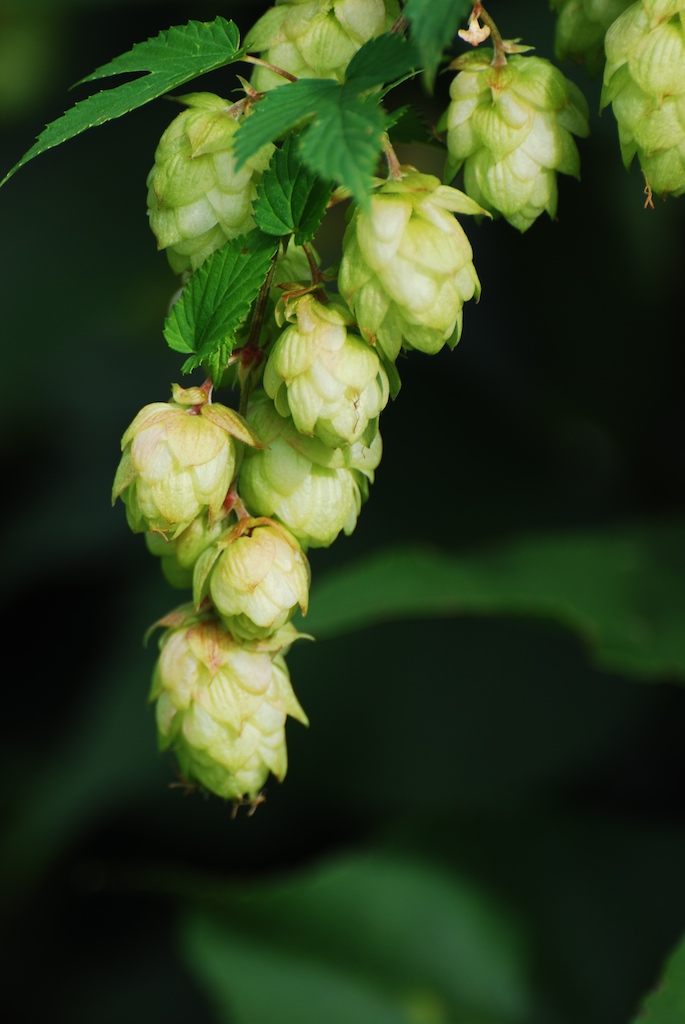
So what in hops give them their characteristic grapefruit like (and other) qualities, and allows them to add bitterness as well? Here’s where this post could very quickly and easily begin to hinge on multi-syllable, vowel-laden words that only someone in a white lab coat might begin to appreciate. While that kind of reading is, to tell the truth, informative and interesting as well, here, we’re shooting for a basic working knowledge. Keeping things somewhat simple, the spotlight will be on two components, the alpha acids and essential oils, both of which are found in the yellow dust known as lupulin, or perhaps more commonly and generally as the “resin”, (of which there are actually more than one type) found at the base of the petals within each hop cone.
In a nutshell, those alpha acids are what brings the bitterness to beer – and essentially, represent the pith of our grapefruit – but only after those acids are exposed to heat and go through a chemical conversion called “isomerization”. To better understand this, I reached out to an actual, real life brewer. Chaos Mountain’s Will Landry was willing to help shed a little light on the role of alpha acids and essential oils in the brewing of beer. Landry: “Alpha acids go through ‘isomerization’ in the boil, which [is a chemical process] that takes that hop resin and turns it into the hop bitterness we know and love in our IPAs”. But a fair amount of time within the boil is needed for this process to occur, generally 45 to 60 minutes or so.
This is particularly important to know because the portion of the resins primarily responsible both for adding the non-bitter flavors to the beer as well as the contributing to the beer’s aroma, the essential oils, are basically lost over that same period of time that is needed to impart bitterness to the beer. In other words, over a 45 to 60 minute boiling time, most of what gives us the flavors and aromas, or our grapefruit “flesh” characteristics of our beer, basically evaporate and are lost. Brewers such as Landry simply get around this by adding hops closer to the end of the boil. Typically, when hops are added somewhere around the 20 to 30 minute mark, a trade-off between adding bitterness and flavor is achieved. Landry continues, “somewhere in between a 60 minute addition and [the end of the boil] lies a window for ‘flavor’ additions. For me it’s about 10-15 minutes left in the boil. This window is where you start to get some conversion [of the alpha acids] but still some oils remain and the result is a ‘balance’ perceived as flavor.” For retaining the kinds of aromas we all love in hop forward beers, brewers add hops within the final few minutes of the boil, or even afterwards, which is called dry hopping.
All this information is better illustrated by taking a look at Landry’s current recipe for Chaos Mountain’s Mad Hopper IPA, which also includes the names of the individual hops (Chinook, Centennial, CTZ, Summit):
 At 60 minutes, Landry uses Chinook hops for bittering, which are also a hop with a fairly high alpha acid content. With an eye towards adding flavor, hops are then added towards the middle of the boil, when “we use a 15 minute addition of Centennial hops, and a 10 minute addition of CTZ.” “These are both high alpha we could use to bitter at 60 minutes, but I prefer the flavors I get with both at this addition.” If you’ve had Mad Hopper, you may notice an earthiness, or even an herbal note within the beer, with a slight citrusy tone in the background. Centennial, one of the most treasured and common hops in hop forward beers, is often described as having citrus like (grapefruit perhaps) or floral attributes, while CTZ, though often used as a bittering hop, can also impart an herbal or earthy flavor.
Finally, Landry adds hops near the end of the boiling process for aroma, choosing more “CTZ hops, followed by an addition of Summit, right as we turn off the heat and stop the boil. Once fermentation is complete we dry-hop with a blend of three more hops.” Summit is often said to give beers an orange, tangerine, or grapefruit like aromas, which you may notice in the aroma of Mad Hopper.
Of course, a recipe such as this is merely one example of how hops are utilized within every beer. An entirely different conversation would revolve around how each type of hop is chosen, in this and every other beer, as well as when they’re used in the recipe, based on their individual characteristics. An in depth conversation about hops might go into the various kinds of alpha acids present in hops and how they differ, or in the essential oils, which possibly number into the few hundred within hops. When brewers purchase hops, they consider their statistics, such as their alpha acid percentage. In terms of how they are used in making beer, you can even start a discussion about the natural pros and cons of using whole cone hops (of which the largely unused portions of the plant can serve as a natural screen to pass beer through, for adding additional aroma or flavor) versus the much more concentrated, dried hop pellets you’ve probably seen before. The role of hops even extends beyond bittering, or even flavor or aroma, to things such as their natural ability as a preservative to helping retain a foamy head.
With all their potential flavor and aroma capabilities, and how those abilities are dependent upon when they’re used in the brewing process, it’s easy to see why brewers are often referred to as half artists (and half scientists). But it’s also no wonder why we continue to be so intensely curious about the next beer that pushes what hops can do front and center.
Cheers!
Posted in Uncategorized





 The Beer Road