
 It all sounds like subplots and locales from either a James Bond or Indiana Jones movie – masses revolting in the streets, new technology “borrowed” from one country and taken to another, Great Britain, The Czech Republic, and Germany. Most folks may not think of such things when ordering a beer, and true, just about any style of beer likely has a long and colorful history. But these things in particular dot the timeline of not just any beer, but what we might as well call “the” beer, the one that changed the face of beer drinking and production worldwide. The one which started out with mass appeal and not a small amount of fanfare, and over the years, has given birth to so many other styles, including the most widely drunk beer throughout the world. I bet Indiana Jones could not only figure out what it is, but track its history all the way to its beginning – after all, it is the beer with a trademark golden color, so it even sounds like lost treasure. As far as for Mr. Bond? He sipped martinis, right? What did he know about good beer?
Of course, this particular beer style would be the legendary Pilsner. It would seem that not one, but all of the typical factors that usually make for major changes in history came together in one place, at one time, to give birth to this game changing beer. The first, pure necessity. Beer drinkers in what is now the Czech Republic, unhappy with inconsistent quality in their beers, begun to demand a change in their beer. The story usually revolves around barrels of the beer they had being dumped into the streets in revolt – a sad day for any brewer, and a tough thought for me even today. A Brewer’s  Guild was formed in the town of Plzen to fix the situation. Necessity, meet opportunity. In a couple other areas of Europe, beer “technologies” which would help change beer forever had been growing. German brewers were really getting their minds around the advantages of cold storing, or “lagering”, their beer, a process that activates the yeast strains which produce the smoother, mellower beers we know as lagers. And in Great Britain, brewers and maltsters had found new methods to produce paler colored malt, or the grain used to produce their beer, which in turn gave them both lighter colors and lighter flavors in beer. These two advancements met with a few regional characteristics, the kind of wheat used, the famous ‘Saaz’ hop favored in the area, and a softer regional water which softened the overall hop bitterness. The result of course was the original Pilsner, the Czech Pilsner. It’s a stlyle that would soon take off in popularity throughout Europe, and thereafter, brewers would attempt to replicate all over the world.
As the story continues, the Germans weren’t about to let the growing popularity of this Czech product steal their own beer drinkers away. But without the particular kind of soft water Czech brewers had at their disposal, and also through the use of regional German barley and hops types, a different style of the Pilsner began to be created, becoming known as, maybe obviously, the German Pilsner. Experts tend to disagree on the finer points here and there, but generally, Czech style Pilsners can be slightly to moderately sweeter, with is sometimes described as a biscuity or cracker like flavor from the malt, feature a little less hop bitterness, and have a wonderful floral aroma (from the Saaz hops). German Pilsners can also have a slightly different but still flowery aroma, are usually more bitter and overall less malty sweet, but are well carbonated and very crisp. Both use types of hops that are referred to as the “Noble Hops”, varieties native to particular European regions, and known more for the flowery or herbal aromas they provide and have generally low “bittering” qualities overall.
 These two styles of beer have a large enough story to tell on their own. But on a larger historical scale, what these brewers provided the beer world with was, in fact, its first pale colored lager. Not only were other beer styles born from the Pilsner, but in the long run, any pale lager you care to pick up at your local restaurant, bar, pub, and so on, owes its existence to the legendary Pilsner. Unfortunately, today, most pale lagers are only that – pale, and yes, they’re lagers. Only similar to the original Pilsner style in that they are light in color, they don’t hold a candle in aroma, taste, character, or any other characteristic to a true Pilsner. Most of today’s light colored lagers are the distant cousin who has traded his lineage for sheer popularity, and forgotten his roots altogether. But there are still heroes around to save the day from those dangerous sounding subplots we started with. There are plenty of imported Czech and German Pilsners out there today which are delicious examples, and in most cases easily found. The other good news comes in the form, yet again, of the American craft brewer. As with so many other European styles, American craft brewers continue to replicate the style while staying close to the lineage of the Pilsner, and many times adjustments only build upon the beer, perhaps making it even better, without trading off of the name of the world’s first golden lager. After all, maybe American craft brewers have a little Indiana Jones in them anyway. Can’t you picture many with a sly grin, (maybe) a fedora, and a look half of ultra resourceful attitude and half of pure mischievous spirit?
Perhaps start with these Czech and Czech style, American craft brewed Pilsners: Měšťanský pivovar Havlíčkův “Rebel” (Czech), Pilsner Urquell (Czech), Žatec Pivovar Zatec (Czech), Samuel Adams Noble Pils (Sam Adams/Boston Beer Co. US), Mama’s Little Yella Pils (Oskar Blues Brewing US), Great Lakes Brewing The Wright Pils (US).
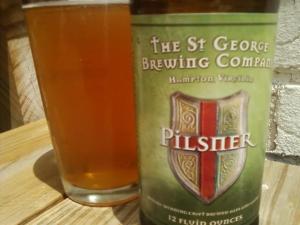
And these German and German style, American craft brewed Pilsners: Bitburger Premium Pils (German), Warsteiner Premium Verum (German), St. George Brewing Company Pilsner (US), Victory Brewing Prima Pils (US), Brooklyn Brewing’s Pilsner (US), Troeg’s Brewing’s Sunshine Pils (US), Tupper’s Hop Pocket Pils (US), North Coast Brewing’s Scrimshaw Pilsner (US)…just to name a few craft brewed German style pilsners out there which are very good.
 A couple weeks ago, some much needed vacation time and my own beer road led me on my annual summer trip to the Outer Banks, North Carolina. Personally, I love being at the ocean. It revitalizes me and puts me at ease like little else can. I owe it to the near perfect weather, beautiful sunrises, and mesmerizing waves that, as usual, I hardly removed myself from beside the ocean the entire week. As far as I’m concerned, planting yourself firmly in the sand for just about the entire week is the perfect way to spend time at the beach. Finding the right beer to compliment those relaxing days on the beach, however, is an interesting and fun topic of conversation among craft beer fans. Some will tell you there is no need for a different beer choice than what you might otherwise drink. You’ll also hear that it’s somewhat unfair to label a particular style of beer a “summer beer”, but let’s face it, when sizzling under the sun in your beach chair, some beers just seem more adept at hitting the spot than others. After all, we all have our favorite company for our beach trips which we hope are available when we make our vacation plans. Ones that simply compliment your time in the heat – they enjoy playing frisbee, you enjoy frisbee, they enjoy long walks on the beach at night, and you do as well..but wait..we’re talking about beer, right? So anyhow, I packed the cooler with some brews that find themselves commonly under the debatable umbrella of “summer” beers – IPAs, wheat beers, and the like, and headed off for a week by the sea.
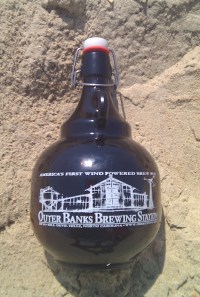 My centerfold luck, in terms of let’s say, Sports Illustrated type models, may always remain the same, which just fine by me, honestly. But in terms of the right beer, things couldn’t worked out much better – my new “companion” was a growler of fresh beer from the
 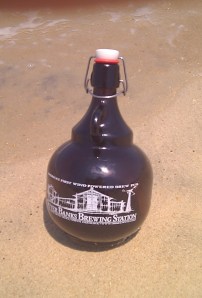 Still other tasty choices continually brew underneath the towering wind turbine. During the Brew Station’s ten years, Brew Master Scott Meyer has not stopped experimenting with various styles of beer. As he writes on the website, “I like to think of our pub brewery as a kitchen rather than a factory. I never stop experimenting. Every brew is the result of the culmination of everything I’ve learned about brewing to date.” When available, the Lemongrass Wheat is not to be missed and another perfect warm weather quencher. The seasonal Santa’s Little Sledgehammer, is an extremely tasty, strong Belgian ale. It’s a fuller bodied, complex mix of malty, dark fruit flavors and with hints of holiday like spices. While we were there, a Dry Irish Stout called Stormy Roses was on tap and was both easy to drink but featured a nicely roasted, rich flavor. Their Hip Hop India Pale Ale is a bold, piney, somewhat aggressive American IPA for any curious hophead. That Cocoa Brown Hefeweizen/Brown Ale blend I mentioned before? That was the second growler fill during the latter half of the week, just delicious. Honestly, I have not had a beer yet from the OBBS that has not become a personal favorite or at the very least impressed me with their character and flavor.
 Easing back into my chair after a trip to the concession stand, I looked out across the left field wall at the green southwestern Virginia mountains, took a deep, satisfying breath, and then a sip of my beer. The game just below me moved for a moment like it was orchestrated, as players moved into position to turn a double play, ending the inning. Another sip of my beer, another glance at the mountains, and a sense of comfort washed over me. Most memories of being at a minor league baseball field on a calm, sunny afternoon go exactly like this one – they are relaxing and somehow deeply satisfying. Indeed, are there many other combinations that go together as well as a summer afternoon, being at a baseball stadium, and sipping a good beer?


 The Beer Road