
There seems to be a natural evolution for craft beer enthusiasts, or the “beer curious”, as I like to call them. It starts with that all important first purchase of “better beer”, or what some call a “gateway” beer. Fueled by curiosity – “what are those other beers in that other cooler over there, and why do they have such odd names?? – and paired up with the fact that each beer curious person has a moment when they’re “ready” for something better, I think every craft beer lover remembers the first beer they tried which they truly loved the taste of. This is the moment which moves the beer curious beyond their taste for their usual mega brewery, available on every corner beer, and the accompanying knee jerk, beer purchasing habits and into something, well, simply – better. It’s the moment that you realize that beer doesn’t have to be just your regular adult beverage ordered without much thought or interest involved – it can just taste so much better too. And yes, it goes down in one’s personal better beer tasting history as the moment a light went on, a true “aha” moment. You know that classic timeline of the evolution of man that you’ve seen a billion times? Imagine a timeline for the beer curious man (or woman). I’d like to think these “aha” moments as the moment midway or more through that timeline, where the beer curious man finally stands up straight (and starts to think for himself). Look closely, what’s he holding? Ok, ok, yes, a hunting spear. No, I meant the other hand – isn’t that a Sierra Nevada Pale Ale bottle?
But once a beer curious person really starts to develop their tastes and move from curiosity towards passion for good beer – somewhat of a snag is usually reached. It’s the actual “hunt” for the stuff. Remember our timeline? Think about our beer curious man’s hunting spear, I guess, if it could be used to take down an ornery, robust chocolate stout you might have read about. To put it simply, sure, a lot of large grocery stores do carry some selection from the bigger players in the craft beer market. But there is just so much out there. The variety of styles is absolutely dizzying – and each brewery has its own distinct take on each style. Not to worry. This is actually a benefit for the beer curious – more to try! (Or for the beer blogger, more “research” to do, as I like to affectionately call it.) However, the vast variety of beer also means that finding it isn’t as easy as you’d like. Most mid-sized and smaller craft breweries have only regional distribution levels. Many times, that is by choice, a choice that may make it hard to find a beer you’ve read about, but one you learn to respect anyway. Shorter travel time for the beer means that whoever tasting it is simply getting a fresher product. It’s part of the charm of craft beer.
It simply means that you have to lean on new resources in order to find the variety. Many large cities have stores that specialize in carrying craft beer. We’re lucky in Roanoke to have the Wine Gourmet down on Franklin Road. The selection is good, it’s constantly updated, and the folks there will go out of their way to make suggestions or get in something you’ve heard about. But still, there is so much out there, right? Again, that’s part of the charm of craft beer – finding it can be fun, and it makes taking a trip to a different city or region that much more interesting. A couple months ago, I took my first trip to Charleston, SC. Sure, I loved the history, the beauty of the historic district, the food – but the beer curious in me was speaking out. I knew there were probably really good things nearby for me to hunt down.
 Did I remember to pack my beer hunting spear? Ah, I mean, do my research? You bet I did. One of the resources that I came across nearly blew my mind, as in “holy cow, this is amazing”. It’s called The Beer Mapping Project, a website that uses Google Maps technology to map out breweries, beer pubs, bars, and even homebrewing stores in various large cities around the country. Want to find the closest brewery to where you’re staying in Washington, DC? The Beer Mapping Project can show you. Keep in mind this also blew my girlfriend’s mind too, but in a totally different way, as in “you’ve got to be kidding me”. (She’s not much of a beer curious person.)
I’m going to be hopefully posting a few more thoughts on what it means to be “beer curious” in the coming days, because quite simply, that’s what this blog is all about. But should you find yourself becoming beer curious and in another city, checking out The Beer Mapping Project will do wonders for you. And even if you’re not travelling soon, check it out anyway – you’ll wish you came up with the idea.
Other resources are out there too – beeradvocate.com, a great site for beer info in general, has a useful beer finder section.
 Another regional brewery has been officially added to the list appearing at this year’s Microfestivus. Joining Floyd’s Shooting Creek and Charlottesville’s Starr Hill, Richmond based Legend Brewery will be represented by four of their brews at Roanoke’s annual beer festival (August 14). I had the chance to chat with some of the folks from Legend a few weeks ago, and the obvious vibe around their tent was that these are people who are truly doing something they love. It’s a feeling that seems to be common around micro brewery folks, but such a positive one it that never gets commonplace. That upbeat feeling, along with the brewery’s close location, and the fact that the brewery’s beers are quite good and come well reviewed, makes it easy to become a fan of Legend.


 Ales and lagers. The primary division between all beers, right? To most casual beer drinkers, one has very little to do with the other. The thought is well rooted in the various myths about the two: lagers are always light colored, light bodied, and hardly bitter at all; ales are always dark, heavy, and sipping an ale turns the unexpecting person’s face all ways of twisted as they exclaim “wow, ugh, bitter!”. Of course, these myths are just that, myths, are hardly true, and we could go through lots of beer style examples to dispel them. But that’s another article. What about a beer that has a little bit to do with both lagers and ales? What would that look like, taste like, and how does a beer actually come to straddle the line between two worlds that at least seem so far apart?
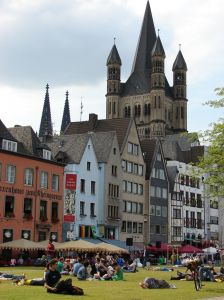 Here’s where a bit of rebellion sits in. Two cities in Bavaria refused to go the way of the lager yeast however, one of which being Cologne, or Köln, who not fifty years after the summer brewing ban went into effect, inacted their own ordinance – there was to be only the brewing of top fermenting beers in the city. So the use of ale yeast in Bavaria would survive, at least in a couple spots. Now throw in one more piece of the puzzle, this one courtesy of the English. At the time, even the cold stored, mellower beers that were growing in popularity by leaps and bounds were still using grain that was malted, or heated, by the use of wood fires. Again, temperature was an issue as it was hard to control steadily, and often, toasting, roasting, or burning of the grain occurred, resulting in a darker malted grain, which resulted in varying degrees of flavor at the least, and a darker, more roasted, and sometimes smoky tasting beer when one wasn’t always the intention. Enter a new level of quality control. Details of just how it happened aside, German brewers began adopting new drying techniques developed by the English which produced a more consistent, lighter colored, and more mellow (less roasted) flavored malt. The resulting paler beers would give what the English needed for their pale ales, what the Czechs needed for their famous pilsner, the Germans what they needed for the classic German lager look, but would also eventually give the brewers in Cologne the look for the beer for which the city is known for – Kolsch. A top fermented (remember, the ordinance!), but cold stored (as a lager would be done, due to the law) beer using pale malts (from the English).





 The Beer Road