Who doesn’t love to tell the story that begins with “ah….how we met…”. For many of us, the tale begins much like it does in the movies, from across a crowded restaurant or a bar on a busy night. You catch a glimpse, and all else in the room stops – at least after the first….taste. It’s the beginning of a long and occasionally intoxicating relationship. Time passes until one day, as you sit at a table together, perhaps at the same restaurant where you met, you have a sudden realization. You may even remember that particular night on which you began to fall in love, but as you recall the days, months, and perhaps years between then and now, it hits you like a ton of bricks. It’s a thought which comes up so often in relationships, and it’s more than a little unnerving. As you glance down, your mind stops on this single thought – “all this time we’ve spent together, but…how well do I really know my beer?”.
For some, it’s enough to know that you simply like the ale or lager in your glass. You know which beers you care for, which ones you don’t, and maybe you have a bit of a hold on why – the flavors are different in each, after all. One’s a bit sweeter, the next too bitter. And that’s fine, of course. But in case you have a curiosity about just how that beer in your glass becomes, well, the beer in your glass, there are a few basic concepts that might help satisfy that curiosity, and also deepen your appreciation for this ancient and always evolving beverage.

Barley
The Grain.
We’ve come a long way since that original German beer law stated all beer must strictly be composed of only water, barley, and hops (and yeast, when everyone began to understand it). For proof of evolution, just pick up the nearest coffee stout, or check out that latest porter that’s had raw peanuts added to it. But at its most basic level, beer is still a beverage made up of a those four core ingredients, and the grain, which in most all beer is barley, plays a vital part. After all, when was the last time you saw a television commercial from one of the bigger brewers in America that didn’t use vast fields of the grain for a backdrop? Advertising practices aside, those pictures and videos of barley, waving romantically in the wind, do remind us that beer truly is a product of the earth. And in a sense, yes, this is pretty romantic. Who doesn’t like the story of how something rises up from such humble and simple beginnings – like big patches of bone dry grass – to help create something so beautiful, like beer?
To understand how that actually happens, all that’s needed is a simple biology lesson and a working understanding of just how that grain ends up accounting for many of the differences in beer, such as color, flavor, and aroma, as well as providing the sugar which converts to alcohol in the end beer. Obviously, those fields of grain don’t come naturally ready to blow your mind the way a good barleywine does. The grain is made ready for use by brewers first in a process calling “malting”, where it becomes – you guessed it – “malt”.
Thousands of years ago, this all may have occurred somewhat by accident and in very natural conditions. Today, the readying of the grain for use by brewers is done by skilled people under much more technologically advanced conditions, but the idea is still basically the same. Kernels of barley are steeped in water to jump start the plant’s natural germination process. Appropriate and effective humidity levels, plenty of evenly distributed oxygen, and carefully maintained temperatures continue the process, which accomplishes a couple vital things. Enzymes within the kernel are exposed, and others are created. Some of these enzymes begin to break down walls around tiny pockets of starch residing inside the kernel, while others will be responsible for completing the actual conversion of those starches to sugar during fermentation later on. Once the kernels have reached a point in their development when they can be most effectively used to brew beer, heat is introduced, basically putting the process on hold until the “malt” can begin to be used in the actual brewing of beer.
It’s important to remember a couple of key facts. First, not all grain to be used in brewing –the great majority of it, but not all – is actually malted. Secondly, the introduction of heat, necessary to keep the malt ready until it reaches the brewers’ hands, actually destroys some of the enzymes created – but enough remain to do the brewer’s work later on. This drying is the beginning of the “kilning” process to make it ready for brewers.
Kilning.

Different types of malts give way to the various colors, and flavors, in beer
Kilning, a process by while heat is applied to the malt to further dry it and give it depth of color and taste, has a rather large effect on how your beer will taste, smell, and even “feel” (mouthfeel). Think about only the color of the last beer you had. It’s easy to take for granted, isn’t it? Stouts are pitch as night, while pilsners are so golden and clear you can see through. Color may be part of any style’s definition, but have you ever wondered how different beer styles, and individual beers, acquire their distinctive colors? As the heat is applied to the malt during kilning, of course, it begins to slowly darken the color of the malt. Think about all the various settings on your toaster. Usually they run zero to ten, or something along those lines. Think about how dialing up the temperature in your toaster affects a slice of bread. Kilning is also done at a variety of temperatures. Lightly heating malt produces, obviously, a lightly golden or pale colored malt and of course one with the accompanying lightly toasted flavor as well. Think of this as the equivalent as the first couple settings on your toaster. Kilning malt at higher temperatures produces more darkly colored malt, with, of course, a more deeply toasted taste, as if you maxed out the setting on your morning toast. As well, some malt types are actually roasted, for an accompanying roasted flavor. These varying degrees of temperature, and their affects on the malted grain, in turn not only influence the color, but also the taste, and the aroma in the end beer. After all, that lightly toasted slice of bread certainly looks, and, more importantly for flavor’s sake – tastes – completely different than the one which is nearly black, doesn’t it.
One of the very interesting things about darker colored malts is how effective they are in changing a beer’s color and flavor. You would think a beer as dark as night would have plenty of those kinds of malt in it, but in most cases, nothing could be farther from the truth. The common analogy used here (and used on the Brewer’s Association website) is liquid food coloring. Remember making something that involved using food coloring, such as cookie icing, when you were a kid? The stuff is highly concentrated, and it only takes a drop or two to completely change the color of whatever you were adding it to. (It’s why those funny little bottles of food coloring stick around for so amazingly long in the cabinet.) Darker malts are the same way. A little amount goes a very, very long way. As a matter of fact, darker malts can make up as little as five percent of the overall grain recipe in a darker beer.
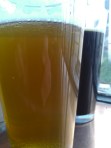
A 4.2% abv stout and a 5.0% abv pale lager.
You can take the busting of such misconceptions one farther, and as a matter of fact, completely obliterate one common (dark) beer myth – that they are always stronger in alcohol content. Remember how heat applied to malt will destroy the enzymes necessary to convert the starches in the malt to sugar (and then to alcohol)? It stands to reason then, that as malt is kilned at higher temperatures, the malt actually ends up having very little, if any, ability to convert the starches which in turn would end up converting to sugar in the end beer. The truth is that it’s actually those lighter colored malts that end up doing most of the work when fermentation occurs, when the alcohol is created. So when it comes to stronger beers, if it’s not the type of malt used, then what is it? It’s very simple – it’s the amount of those paler malts used that are used, period. To oversimplify, the more malt used, the more starches, more enzymes, then more sugars, then more alcohol in the beer. One famous example is your typical Guinness found most in most any store or bar you care to look. You’ve had one, I know you have. Dark as night, yes – but the beer actually has the same alcohol content as a nearly crystal clear Miller Light.
While these lightly kilned malts, some of which are called “base malts”, have most of the enzymatic power needed to convert the starches in malt to sugar, the malts which are kilned at higher temperatures are called “specialty malts”, and are the ones that add flavor complexity and color to beer. Enjoy Oktoberfest style beers? Certain types of these malts, like “Munich Malt” and “Vienna Malt” give these beers part of their characteristic richer, grainier flavors. The Specialty Malts also include a few malts which are created by processes other than kilning, or by a combination of the two. One of the most well known of these specialty malts are different types of “Crystal Malts”, which are created by stewing the kernels in an damp oven like environment, and then drying them at various temperatures. The whole process creates crystalline, sugary substances inside the kernel’s hull, which are greatly responsible for the caramel like, sweet flavors found in certain beers (as well as adding some weight to the mouthfeel of the beer). One of the interesting things to remember about the more highly kilned malts, as well as even the roasted ones, still have the starches in them that could be converted to sugars. Remember that all of these heating processes destroy the enzymes, not the starches. The enzymes in those base malts actually have the capability to convert the starches to sugars in both themselves and in the more deeply heated malts!
Once the malt is kilned, the kernels are then partially cracked open in a process called milling. By doing so, more of their surface area will be exposed, making it easier for the brewer to utilize all that the malt gives beer – flavor, color, the enzymes, the starches – in the next step of the brewing process, called mashing.
Mashing
The brewing process really gets going during the mashing process. During the mashing, most, if not all, of the malt to be used to achieve the desired kind of beer is added to a large vessel of hot water known as the mash tun. Mechanical arms move through the mash tun, stirring it in a manner of speaking, it to ensure that the process occurs evenly, and the environment allows for the enzymes to continue doing their work, breaking down the starches to fermentable sugars. Of course, the various malts which have been added to the mash will impart their color and flavors, each adding a layer of complexity to the mixture.
Of course, this is another huge oversimplification of the process. To say that that all one has to do is throw the malt into some hot water, move it around a bit, drain it, and eventually you’ll have beer is a more than a bit of an understatement. A brewer makes adjustments during the mashing process, mainly through changing the temperature of the mash, which in turn changes the chemistry of the sugars created. This can impart slightly different flavors, for example, in the beer. One interesting example of how changing the temperatures in the mash can greatly affect the beer’s final taste involves how a brewer can affect the chemical structure of the sugars being created. Truth be told, a brewer might not want all the sugars created during the mash to actually be fermentable. Sweeter beers, such as a Wee Heavy for example, have a fair amount of what’s called residual sugars that end up in the final beer, giving that style its characteristic sweetness. The brewer makes this happen during the mashing process. Varying temperatures in the mash cause different enzymes to work in different sorts of ways. By adjusting the temperatures, a brewer can cause the enzymes to create sugars which are more difficult for the yeast to break down and convert to alcohol during fermentation later on, and therefore, are basically left in the end beer to make it “sweeter”, as in certain styles, like a Wee Heavy, for example.
After mashing, the sugary liquid, called “wort”, is drained through filters in the bottom of the mash tun, and sent off to another vessel, the brew kettle. At this point, the liquid is a pretty sweet substance indeed. This is why when we taste a beer with a bit more of a sweeter side than a bitter or “hoppier” presence, we often will say that it is “malty”. However, at this point in the brewing process, it is decidedly sugary, so it is during this next step that another ingredient will be added to help balance the concoction out. If you guessed that this is where those darn bitter hops come in, you’re right – but that’s a different article for another time. For now, the beer is well on its way to becoming the beverage you love, and now, perhaps know a bit more about.
True, beers come and go. Old favorites fade into the past, occasionally revisiting you for a warm reunion now and again, but they also give way to new ones. As you sit at that table, looking down at your glass and thinking back, you may remember ones that didn’t quite treat you well – that uninteresting blonde (lager) you met on vacation, that uneven, boozy red (ale) last winter – but even those are remembered with a bit of nostalgic haze. It’s of course the good ones – beers, that is – the well crafted ones, which really help develop your appreciation of beer. It’s an appreciation that deepens with just a bit of knowledge of how each one’s earth born ingredients are coaxed into endless variations of flavor, aroma, and color through the efforts of the brewers. It’s enough to make anyone want to re-tell the story of the first really good beer you had, or the first time you tasted your all time favorite IPA. Go ahead, there’s really nothing wrong with feeling a little romantic about it. Just don’t wink at your beer, that’s just a little too much. That satisfied grin after taking another sip from your glass will probably do just fine.
***A big thank you to Mr. Will Landry, who recently completed the American Brewers Guild Craft Brewers Appreticeship course, and who has been homebrewing since 2007 and previously served as the President of the Star City Brewers Guild here in Roanoke, for his assistance (and patience) with me on this post.
Posted in The (Beer) Road Less Traveled - Getting Into Better Beer.

 Valentine’s Day was not yesterday, regardless of what the calendar said. At least not as far as stout fans in Mid Atlantic states were concerned. That came on February 1st, when Foothills Brewing tapped the first keg of their highly sought after, once a year release Imperial Stout Sexual Chocolate, and caused those stout swoon once again over the deeply roasty, smooth as silk, pitch black ale. Tasting notes include a velvety body, flavors of molasses and faint raisin or plum, some bittersweet chocolate, possibly a little roasted coffee, with some heat from the alcohol. When tasting, let this warm some, as all those flavors and the smooth body will continue to show themselves. It is a top tier Imperial Stout to be certain. But in case you doubt how some folks go nuts over this beer, consider that people were allowed to start lining up outside the Winston Salem brewery at 2am the night before the release, camping was allowed, and there were local police officers on hand just to make sure things remained calm. Yes – it’s that big of a deal.




 The Beer Road