 Beer and its history. The two truly go hand in hand. You can’t really enjoy one of the world’s oldest beverages without someone at the table at least attempting to make a couple of historical bullet points. When it gets down to it, there is a certain romanticism that goes along with truly enjoying a beer and feeling that it somehow has ties to ancient civilizations. Even if what you’re drinking is a golden, beautiful, clear pilsner which has been delicately poured into your glass, and in many ancient civilizations, would be “beer” drinkers drank a beverage which was more akin to something called gruel which was sucked through reeds in order to try and avoid chunks of various solids left over by the brewing process of the time. Indeed, chances are good that no one at your table will mention gruel or sucking beer through reeds. This is a good thing, considering the affect such a story would have on everyone’s appetite. Thankfully and more likely, someone will update the discussion with talk of beer brewing monks and the Old World, and that gleam in your beer loving eye begins to come back. Sort of.
So I thought I would update the discussion quite a bit this time, and narrow down the history of beer to how it developed in our own Roanoke area. Not just because I live here, but because with all the craft beer interest that’s beginning to simmer in the Roanoke and New River Valleys – multiple restaurants featuring craft beers on tap, Roanoke’s annual craft beer festival growing each year, Blacksburg adding another craft beer store this month are all examples – I thought it was a good time to look back at our own local beer history. To see where we’ve come from, as it were. At the very least, it would make for good beer discussion fodder. And no matter what I found, I was pretty sure I wouldn’t discover that Roanokers ever attempted to drink beer through reeds.
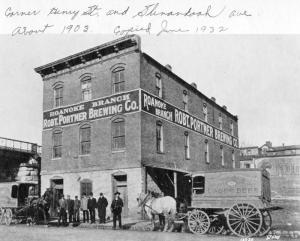
One name that often pops up in Roanoke beer lore is that of Robert Portner. In the late 19th century, Portner’s Brewing Company, based in Alexandria, became one of the south’s largest breweries and in 1885, the company began operating a depot in Roanoke, for their beer to be shipped to and bottled.[i] The depot was located along Shenandoah Avenue just a few blocks behind the Hotel Roanoke. While Portner’s beers were widely distributed – shipments reached into Georgia at one point – it was Portner’s innovations that often gained recognition.[i] In the 1880’s, brewers began to use some of the first artificial refrigeration machines and air conditioning units to help regulate beer temperatures during production and for the storage of lager beer. There were many designs of the devices, with varying degrees of success, but it was a design that Portner made his own modifications to that apparently became one of the more efficient ones used by any brewery at the time.[i]
But while the Robert Portner Brewing Company shipped their beer to Roanoke to be bottled, the Virginia Brewing Company, or VBC, brewed their beer right here in what was often referred to as the “Magic City”. As far as I could tell, the VBC was situated near the corner of what is now Norfolk and Wise Avenues, which would’ve placed it right across from the railroad’s machine works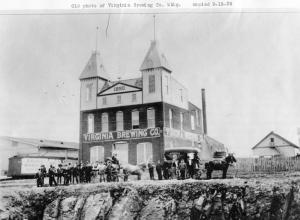 . Not only was the operation located here in Roanoke, but the VBC prided itself on having been established by several businessmen who were native to the area, a fact that would make it a regional favorite among nearby saloon owners, and would also come to aid them quite well in their defense against outside competition.[ii] The owners hired a German born brewmaster named Louis Scholz to manage the company and its beer production. In 1890, the company’s first beer, a pilsner, went on sale, and as the story goes, the company had sold their entire supply by mid afternoon of the first day of bottling.[ii] Distribution would soon expand into central Virginia locations such as Lynchburg and Shenandoah, as well as into North Carolina, but the brewery’s growth seemed to be not just based on good business strategy and their reputation as a local brewery. Apparently, the beer was quite good, and the pilsner won a gold medal at the 1907 Jamestown Tercentennial Exposition’s beer competition.[iii] It also didn’t hurt that at the time, there wasn’t much competition in the area. In fact, Portner’s Brewery seemed to be the VBC’s primary opponent, but shipping from Alexandria meant selling their beer at higher costs, and they lacked the local “flavor” the VBC had. Not even a fire which destroyed their facility sometime in the early 1890’s could stop the VBC, as the brewery quickly rebounded, enlarged their operation, and grew from bottling 6,000 beers when it began in 1890 to nearly three million in 1905.[iii] But no other story seems to prove both the popularity and the quality of VBC’s beer as like the well documented battle it eventually waged with a growing brewery from St. Louis called Anheiser-Busch.
Around 1892, perhaps driven by disappointing sales in the area, Anheiser-Busch launched the tactic of aggressively cutting the pricing of their barrels to below the actual cost of production, becoming the least expensive beer in town.[ii] The strategy was one apparently used in many cities by Anheiser-Busch, and here in Roanoke, seemed to be aimed solely at the VBC. In what might seem very odd by today’s standards though, Anheiser-Busch’s move would eventually fail, as editors at The Roanoke Times took sides and vocally rallied behind the VBC, calling the local brewery a “home enterprise….built up and owned in great part by Roanoke people”, and one that “deserved every residents’ patronage, even if it meant paying a few cents more for a mug of beer.”[ii] The editors continued, calling Anheiser-Busch a “foreign enterprise”, with plenty of capital to bring down the VBC.[ii] Bolstered by the hometown support, Anheiser-Busch would eventually concede their plan, and return the pricing of their barrels to earlier levels. The battle between the local brewery and the growing giant was certainly interesting in its own right, a true story of a local business taking on the larger, nationally known giant and winning. But more interestingly, I couldn’t help but think how this particular “Beer War”[ii] from nearly 120 years ago seems to strangely mirror the type of struggle today’s craft brewers sometimes face with large macrobrewers.
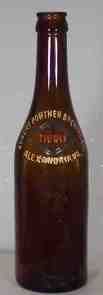 Needless to say, prohibition changed the face of both the Portner and VBC companies for good. Virginia approved prohibition roughly four years before it was a nationwide law, in 1916. The Robert Portner Brewing Company had, as many breweries did, begun bottling soda, but could not sustain itself with only this. The company attempted ventures into real estate and the production of feed for farms with only limited success. Rumors circulated about a comeback for the brewery that never occurred. Over the years, the buildings in which the Alexandria brewery once operated changed hands several times, and each time one or another were repurposed or demolished. The only substantial remnant of the brewery is the former bottling house, now home to condominiums.[i]
As for the VBC, after prohibition, it also attempted a comeback. However, before the first new VBC beer could hit the market, Louis Scholz passed away and his heirs sold the brewery. Over the years, the facility would be owned by other brewers and breweries, first in attempts to revive the VBC name and later to use the facilities for their own companies. Finally, in 1964, the original brew house was torn down to reuse the lot for other purposes.[iii]
So as it turns out, we Roanokers have our own historical bullet points to make. As interest in good beer in the area continues to grow, those discussions woven lightly with beer lore will undoubtedly grow as well. But we don’t necessarily need to bring up the Old World, drinking beer through reeds, or even those crazy beer loving monks. We can sit around our table, friends gathered on the next lazy summer evening, and after a few quality brews, talk about how our own brewery was based near the Norfolk and Western machine shops we drive past today, and how it once fought off the big boys. Settling a little more into our chairs, and with deeper reflection, someone will recall the brewery’s name, and then the whole table will undoubtedly, finally wonder just how good the beer must have been.
[i] Robert Portner And His Brewing Company, by Timothy J. Dennee, for Saul Centers, Inc., Parsons Engineering Science, Inc., and Alexandria Archaeology. Document found on the alexandriava.gov website.
[ii] Roanoke, Virginia 1882-1912 Magic City of the New South, by Rand Dotson. Published by the University of Tennessee Press.
[iii] Dotson, Paul R. (2003) Magic City. Class, Community, and Reform in Roanoke, Virginia 1882-1912. A Dissertation submitted to the graduate faculty of the Louisiana State University and Agricultural and Mechanical College. From The Electronic Thesis and Dissertation Library of Louisiana State University.
The photos of the Robert Portner Brewing Company depot and Virginia Brewing Company buildings are from the Norfolk Southern Archives, used with their permission. They can be found on the Virginia Tech Imagebase. The individual pages for the photos are as follows.
http://imagebase.lib.vt.edu/view_record.php?URN=ns5770&mode=popup and
http://imagebase.lib.vt.edu/view_record.php?URN=ns5718&mode=popup
Also, thank you so much to Mr. Mike Cianciosi for letting me use an image from his collection of beer and soda bottles. His website can be found here.
Posted in The (Beer) Road Less Traveled - Getting Into Better Beer.

 This blog is about what’s in that “other” beer aisle. The one a bit less traveled, the one without the Buds and Millers of the world. For some, the aisle is a familiar place. But for many others, the aisle is curiosity, and the beer there is unfamiliar to them at best. Many times, I’ve seen folks standing in it, glancing at the six packs on this aisle, examining their colorful packaging and often more colorful names, unsure of what’s really there in front of them. My girlfriend, not really a beer person herself, is often amused by these names – ones like “Old Leghumper” and “Arrogant Bastard” – and likes to call them out. Aloud, mind you. Right there in the aisle, while chuckling a bit. It’s something we’re trying to work on.
 down into three distinct areas – “Small”, “Independent”, and “Traditional”. First, that the brewer is “small” means that their annual production is six million barrels of beer annually, a number that only one craft brewing company will most likely reach in the coming years; two, that the brewer is “Independent”, meaning that less than 25% of the brewery is controlled or owned by an alcoholic beverage industry member who is not themselves a craft brewer; and lastly, that the brewery is “Traditional”, in that the beer the brewery is most known for, their “flagship” beer, is an all malt beer, or that the brewery has at least 50% percent of its volume in either all malt beers or beers in which adjuncts are used to enhance the flavor of the beer instead of lightening it. These three areas of definition are all important in their own way, but to let’s start with those production and sales numbers, and add some perspective. While six million barrels of beer might sound like a fair amount, only Samuel Adams (Boston Beer Co.) stands to close in on that mark in the future. Currently, Sam Adams stands around the two million barrel mark, and even well known Sierra Nevada is hovering around one million. Just two or three spots down are breweries playing in the five hundred thousand or so range. The point is, these are the largest of American craft breweries by a long shot. According to the Brewers Association, all of the craft brewers in America accounted for just over nine million barrels of beer sold, according to 2009 numbers. To truly put this in perspective, and compare it to a company we’re all familiar with, a 2007 financial report from Anheiser Busch listed the number of barrels sold at 128 million.
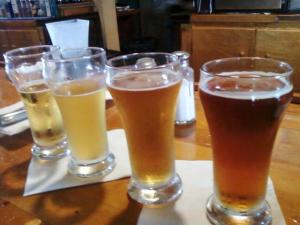 meone veering towards the line at which the major brewery product goes toe to toe with the craft one, and the topic of quality comes into play. Let me simply point out the obvious. Craft brewers are in it to make excellent beer. They aren’t going for the beer with the ability to appease the greatest amount of folks possible. After all, many are former home brewers at heart, a mix of both scientist and artist, and would generally like to simply blow their own mind, and then yours, with their latest offering. Many are students of the beer world and its history, hence the dedication to explore so many of the worlds’ beer styles – of which there are as many as fifty or more instead of just one or two. At the heart of their work are beers with bold characters, big or delicately designed flavors, subtle nuances, and that full sensory experience that’s possible when holding one in your hand. So if you’re reading this, I would imagine that you’re at least curious about this huge, interesting, and delicious world of craft beer. So am I. It’s the reason I started the blog. Now, keep in mind, there are a lot of beers out there. Variation dominates here. Each and every beer is different from the next, even if they’re described as being the within the same “style”. So when diving into that world, you may not instantly love everything you get your hands on. This is completely fine and it’s to be expected. If one particular American Amber Ale is pretty good, the next might really knock your socks off. Again, this is the fun part of craft beer, discovering those slight differences between one beer and the next. It’s a happy situation that I fondly refer to as “research”. True, the blog started as my own journal through the craft beer world. But as I discover craft beer myself, I hope it can help other craft beer curious folks navigate through it as well. Even if you’re somewhat familiar it and have already begun your journey, I hope the information here can offer some additional help. Either way, I’ll see you in that “other” aisle.
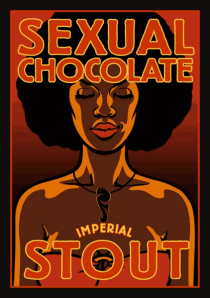 January 29th marked this year’s debut of Foothills Brewing’s annually released – and widely loved – Imperial Stout Sexual Chocolate. While Foothills celebrated the date by having a kick-off party at their brewery in Winston Salem, if you were unable to attend it on that day, or if you don’t live in that area, getting your hands around a single pint of this amazing stuff can sometimes make for a bit of a challenge. Who knew, then, that Valentine’s Day would give you exactly that opportunity, because on Monday the 14th, Sharkey’s in Radford will be tapping a keg of this highly anticipated stout. If you haven’t had it before, not only can you try this very good beer, but you now have the kind of non-traditional, creative, atypical Valentine’s Day plans that your better half has always wanted you to come up with. (Or at least that’s how I’d try to sell it.)



 The Beer Road